Article in Filtration
How Aquaponics Filtration Actually Works (And Why Most Aquarium Owners Get It Wrong)
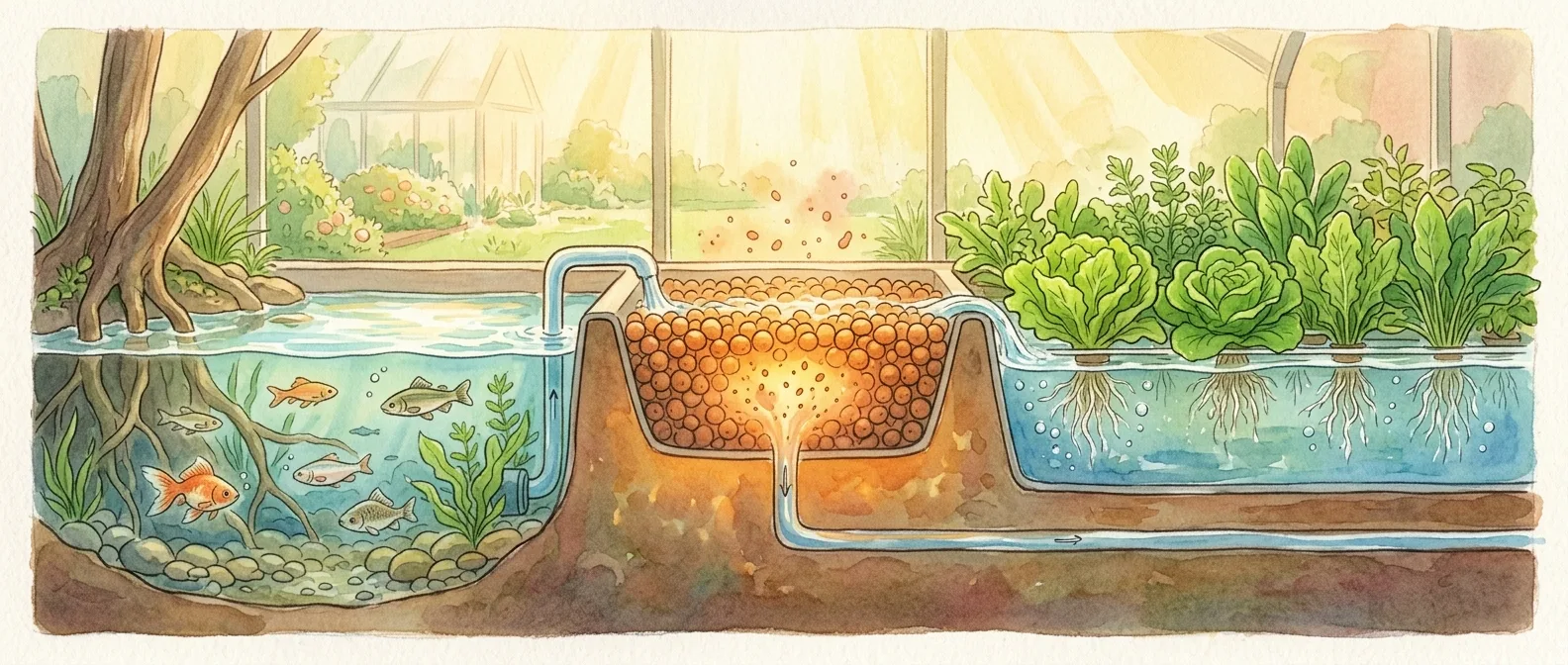
Most people who keep fish treat filtration as a single problem: remove visible waste. They buy a hang-on-back filter, stuff it with carbon and foam, and call it done. That approach keeps a tank running, but it misses the core mechanism that makes aquaponics so different from conventional aquarium-keeping, and so much more stable once it is set up correctly.
Aquaponics filtration is not one process. It is three simultaneous biological and mechanical processes that have to be balanced against each other. Get that balance wrong and you get either fish stress or nutrient-starved plants. Get it right and the system becomes genuinely self-regulating in a way that a standard aquarium never achieves.
Mechanical Filtration: Capturing Solids Before They Break Down
The first stage is straightforward: physical removal of solid waste before it has a chance to decompose in the water column. Fish excrete solid waste constantly. If that waste sits in the water and breaks down anaerobically, it produces ammonia spikes, hydrogen sulfide, and a biological oxygen demand that the rest of the system cannot handle.
In a desktop or small-scale aquaponics system, mechanical filtration typically happens through a grow bed filled with media, such as expanded clay aggregate, lava rock, or similar porous material, that physically traps solids as water flows through. The media acts as a settling bed and a biofilm surface simultaneously. In larger systems, a dedicated clarifier or swirl separator handles this stage before water reaches the biofilter.
The mistake most beginners make is skipping this stage or undersizing it. A grow bed that is too shallow will not trap fine particles. Water returns to the fish tank carrying decomposing organic matter, and the bacterial population in the system never stabilizes.
Biological Filtration: The Nitrogen Cycle Is Not Optional
This is where aquaponics diverges most sharply from hydroponic growing and from conventional aquarium management. The nitrogen cycle has to be fully established before the system can support both fish and plants at healthy densities.
Ammonia is the direct output of fish metabolism. At concentrations above about 2 ppm, it is acutely toxic to most freshwater fish. Nitrite is equally dangerous. Nitrate, the end product, is relatively benign to fish at the concentrations seen in a balanced system, and it is the primary nitrogen source for plant uptake.
The colonies of Nitrosomonas and Nitrospira live primarily on surfaces, on the media in the grow bed, on the walls of the tank, on any submerged structure with sufficient surface area and oxygen exposure. This is why media selection matters: you are not just picking a physical filter substrate, you are engineering habitat for bacteria. Expanded clay has a surface area of roughly 250 to 300 square meters per cubic meter. That translates directly into the bacterial biomass the system can support and therefore the fish load the system can handle.
Cycling a new system, establishing these bacterial colonies from scratch, typically takes three to five weeks. There are no shortcuts. Adding fish too early crashes the system before the bacterial population can process the ammonia load.
The Plant Uptake Stage: Where the System Closes the Loop
Once nitrate is present in the water, the plants take over. Roots in direct contact with the recirculating water absorb nitrate, phosphate, and trace minerals. In a correctly stocked system, plant uptake keeps nitrate below 80 ppm, the threshold where even nitrate-tolerant fish begin showing stress.
This is the feedback loop that makes aquaponics self-regulating: fish produce ammonia, bacteria convert it to nitrate, plants consume the nitrate, and clean water returns to the fish. The conventional aquarium requires regular partial water changes to remove accumulated nitrate. A balanced aquaponics system does not, because the plants are continuously performing that function.
Why Desktop Systems Challenge These Principles
Scaling aquaponics down to desktop size, a tank in the 3 to 10 gallon range, compresses every margin for error. Water volume is small, so ammonia spikes are faster and more severe. The grow bed has less surface area for bacterial colonization. Temperature fluctuations from ambient room conditions affect bacterial activity directly: Nitrosomonas works optimally between 25 to 30 degrees Celsius and slows significantly below 20.
The design choices that make a compact system work center on maximizing the biological surface area relative to the water volume, maintaining a flood-and-drain cycle that keeps the grow bed alternately wet and oxygenated (essential for aerobic nitrification), and selecting a fish species, typically a Betta or a small school of tetras, whose bioload matches what a small grow bed can process.
What "Low Maintenance" Actually Means
When a compact aquaponics system is marketed as low maintenance, that claim is accurate, but only after the cycling period is complete and the system is correctly stocked. During the first month, the system demands close attention: daily ammonia and nitrite testing, conservative feeding, and patience.
After that establishment period, maintenance genuinely drops. Weekly top-offs for evaporation, occasional plant harvesting, and feeding the fish. The biological engine runs itself. That is not a marketing promise. It is the outcome of three processes working in coordination.
Understanding those three processes, mechanical capture, biological conversion, plant uptake, is the prerequisite for troubleshooting any problem that appears later. Cloudy water, fish gasping at the surface, yellowing plants: each symptom maps to a specific stage in the filtration chain. Fix the process, and the symptom disappears.