Article in Plants
Top Plants for Aquaponics Filtration Efficiency
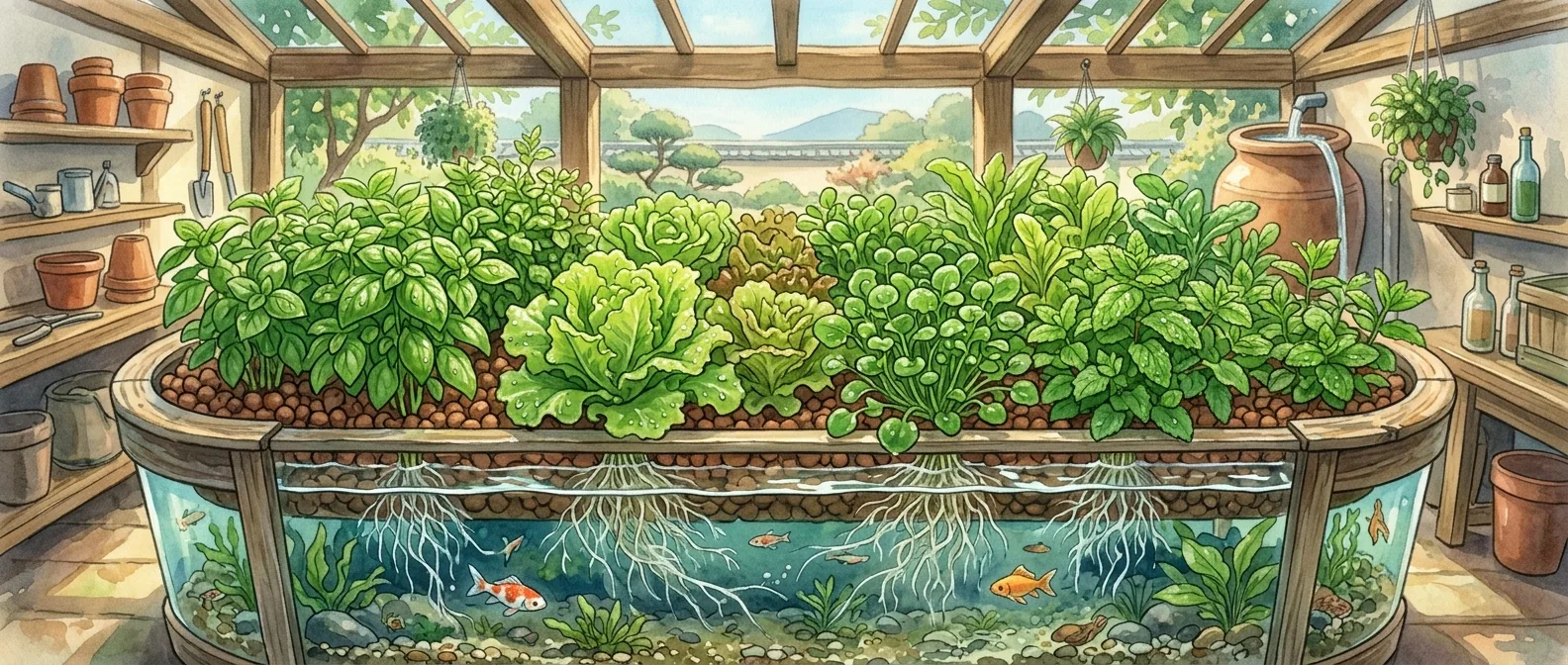
Plant selection in aquaponics is usually framed as a growing question: what will produce well in a flood-and-drain bed? That framing is incomplete. Plants in an aquaponics system are not just crops. They are the final stage of the filtration chain. The species you choose, and how you manage them, determines how much nitrate and phosphate the system removes from the water column. Choose poorly and you carry elevated nutrient concentrations that stress your fish regardless of how well the bacterial stage is performing.
The plants that work best in aquaponics filtration share specific traits: fast nitrogen uptake, tolerance for wet roots, and a root architecture that maximizes surface contact with recirculating water.
Basil
Basil is the benchmark plant for aquaponics filtration performance. It establishes quickly, produces a dense, fibrous root mass within two to three weeks of germination, and has a nitrogen demand that tracks well with the output of a lightly stocked fish tank. In a desktop system with a single Betta or a pair of small fish, one or two basil plants in the grow bed will typically keep nitrate below 40 ppm without any water changes once the system is cycled.
The practical advantage beyond filtration: basil signals system health visually. Pale, yellowing leaves indicate nitrogen deficiency, which in a healthy system means the plants are outpacing bacterial nitrate production and you should consider adding fish or increasing feeding. Dark, over-saturated green with leggy growth suggests the opposite: fish load exceeds plant uptake and nitrate is accumulating.
Sweet basil (Ocimum basilicum) is the most common choice. Genovese performs reliably; Thai basil grows more aggressively and can outpace filtration needs in a very small tank.
Watercress
Watercress is native to flowing water and its filtration performance reflects that. It is among the fastest nitrogen-uptaking plants available for aquaponics. Studies on constructed wetlands consistently show watercress removing nitrogen at rates that outpace most terrestrial herbs by a significant margin.
For desktop systems, watercress has one limitation: it grows fast enough to overwhelm a small grow bed within four to six weeks. That is a harvesting problem, not a system problem, but it requires attention. Harvest the top third of the plant every two weeks and it will regenerate without becoming root-bound. Let it go too long and the root mass will restrict water flow through the media, reducing oxygenation to the bacterial colonies underneath.
Watercress also tolerates water temperatures down to 10 degrees Celsius, which makes it useful in setups where ambient temperature control is limited.
Lettuce
Loose-leaf lettuce varieties, particularly butterhead and oakleaf, are the most forgiving aquaponics plants for beginners and among the most consistent performers in continuous-harvest systems. They establish faster than basil, tolerate a wider pH range (6.0 to 7.5), and produce a root structure that colonizes media thoroughly without causing flow restriction.
The filtration efficiency of lettuce is moderate compared to watercress, but its growth habit makes it ideal for system management: harvest outer leaves continuously and the plant keeps pulling nitrogen without needing full replacement. A three-plant rotation in a small grow bed, staggering planting by two weeks, maintains near-constant uptake throughout the year.
Red varieties (Red Sails, Lollo Rosso) grow marginally slower than green varieties but show anthocyanin stress coloration more clearly, which adds a secondary diagnostic signal for pH fluctuations in the water.
Mint
Mint is an aggressive nitrogen scavenger. It develops a lateral rhizome root system that spreads through grow bed media and creates a dense uptake surface. For systems that are overstocked relative to grow bed size, mint can function as a buffer that keeps nitrate manageable while you adjust fish load or expand grow area.
The management requirement is containment. In an open media bed, mint will monopolize space within one growing season. Keep it in a mesh pot within the grow bed or dedicate a separate media zone to it. Used that way, it performs reliably without crowding out other plants.
Spearmint and peppermint both work; spearmint tends to be more vigorous in flood-and-drain cycles.
Peace Lily
For purely ornamental setups, peace lily (Spathiphyllum wallisii) is the standard recommendation. It tolerates low light, thrives with its roots in direct water contact, and removes both nitrate and phosphate efficiently.
Peace lily is also one of the few aquaponics-compatible plants that can grow with its roots submerged rather than in flood-and-drain media. In open-top aquarium setups where the plant sits above the tank with roots trailing into the water, it functions as a continuous passive filter without any pump-driven media cycle. That makes it the practical choice for the smallest desktop configurations where a full grow bed is not feasible.
What Not to Plant
Avoid deep-rooted vegetables (tomatoes, peppers, squash) in systems under 20 gallons. Their nitrogen demand is too variable, low during vegetative growth, high during fruiting, and their root systems will compact a small media bed within a single season. They work in large flood-and-drain troughs but create management problems in compact systems.
Avoid aquatic plants intended for submerged growth, like anacharis or hornwort, in the main grow bed. They belong in the fish tank if at all, and their nutrient uptake from the water column is less efficient than plants with aerial growth above the waterline.
Matching Plant Selection to Fish Load
The practical way to evaluate plant choice for your specific system: measure nitrate weekly for the first eight weeks after cycling. If nitrate is climbing above 60 ppm, either add more plant mass, increase harvesting frequency on existing plants, or reduce fish load. If nitrate is stable below 20 ppm with no water changes, your plants are outpacing your fish and you have capacity to increase stocking density.
Plant selection is not a one-time decision. It is an ongoing calibration against the biological load in the tank.