Article in Setup
Starting a Desktop Aquaponics System: A Practical Setup Guide
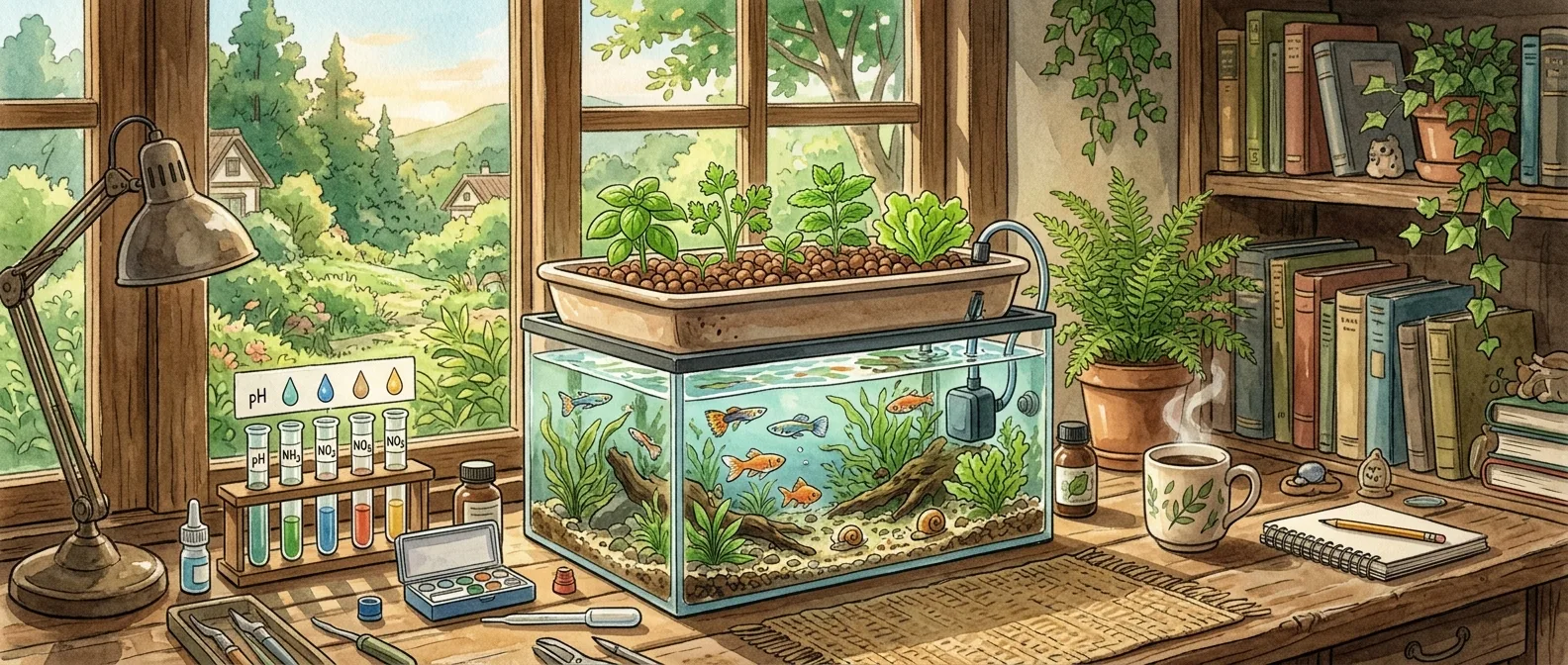
There is a predictable failure pattern in desktop aquaponics: someone sets up a compact system, adds fish immediately, and watches it crash within two weeks. The fish die, the water turns green, and the conclusion is that aquaponics is difficult or unreliable. The conclusion is wrong. The system failed because the biological infrastructure was never established before it was loaded.
A desktop aquaponics system can run stably for years with very little weekly maintenance. Getting there requires following the correct sequence during setup. Skip a step or rush the timeline and you build a fragile system that demands constant intervention.
Choosing the Right Tank Size
The minimum practical tank size for a stable desktop aquaponics system is 3 gallons. Below that, water chemistry changes too rapidly for most beginners to manage.
Five to ten gallons is the sweet spot for first-time setups. The water volume provides enough buffering that a day or two of inattention does not immediately produce a crisis. It is also large enough to support a small school of fish alongside a properly sized grow bed.
The grow bed should have volume equal to roughly one-third to one-half the tank volume. In a five-gallon system, that means a grow bed holding approximately 1.5 to 2.5 gallons of media. This ratio ensures enough bacterial surface area and plant root volume to process the bioload from the fish.
Selecting and Preparing the Grow Media
Expanded clay aggregate (hydroton, LECA) is the standard choice for compact aquaponics grow beds. It is pH-neutral, reusable, provides good drainage and aeration during the drain phase of a flood-and-drain cycle, and has enough surface area to support a substantial bacterial population.
Prepare the media before use: rinse it thoroughly until the runoff is clear, then soak it in pH-neutral water for 24 hours. Fresh clay aggregate can have a slightly alkaline surface residue that will push your system pH above 8.0 during cycling. Most beneficial bacteria and most plants prefer 6.8 to 7.2.
Lava rock is a lower-cost alternative with even higher surface area per unit volume. It is heavier, harder to rinse, and slightly more variable in pH behavior, but it performs equivalently once established.
The Cycling Phase: The Most Important Four Weeks
Do not add fish until the system has cycled. This is not optional advice.
Cycling means establishing the two bacterial populations responsible for nitrification: Nitrosomonas (converts ammonia to nitrite) and Nitrospira (converts nitrite to nitrate). Neither population exists in meaningful numbers in a new system. Both take time to grow to a density that can process the continuous ammonia output of living fish.
Fishless Cycling Protocol
Add a source of ammonia to the filled system. Pure ammonia (ammonium hydroxide, fragrance-free and surfactant-free) at a dose that brings the tank to approximately 2 ppm is the most controllable method. Aquarium-specific ammonia sources and commercially sold bacterial seeding products also work.
Test the water every two days with a liquid test kit, not test strips, which are too imprecise at the concentrations that matter during cycling. Track ammonia, nitrite, and nitrate.
The progression runs in three stages:
- Ammonia rises to target level, then holds. Nitrite is zero. Nitrate is zero.
- Nitrite begins to rise as Nitrosomonas colonizes. Ammonia drops as it is converted. Nitrate appears in small amounts.
- Nitrite begins to fall as Nitrospira colonizes. Nitrate rises. Ammonia drops to near zero.
The system is cycled when you can dose ammonia to 2 ppm, return 24 hours later, and find ammonia at or near zero, nitrite at or near zero, and nitrate elevated. That typically takes three to five weeks from a cold start. Adding media or water from an established system shortens the timeline significantly.
Accelerating Cycling
The most reliable way to cut cycling time in half is to seed the system with established bacterial colonies. Sources include media from a running aquaponics or aquarium filter, gravel from the bottom of a healthy tank, and commercially bottled nitrifying bacteria (Tetra SafeStart, Stability, or Fritz Zyme 7).
Even with seeding, complete cycling still takes ten to twenty days minimum. The bacteria need time to reproduce to a density that matches the incoming ammonia load.
Adding Fish: Stocking the Right Way
Add fish only after the cycling test passes. Stock conservatively on day one, at half the intended final load. Give the system two weeks to adjust bacterial populations to the new continuous ammonia source before adding the remaining fish.
For a 5-gallon desktop system, appropriate stocking includes one male Betta (by itself), 6 to 8 chili rasboras or ember tetras, or 6 to 8 white cloud mountain minnows. Goldfish are frequently suggested for desktop aquaponics because they tolerate a wide range of conditions. Avoid them in any system under 20 gallons.
The First 30 Days After Stocking
Feed lightly, less than the fish will consume in three minutes, once per day. Excess food is the most common cause of ammonia spikes in newly stocked systems. Feed less than you think you need to for the first two weeks.
Test water chemistry twice weekly for the first month: ammonia, nitrite, nitrate, pH. A correctly cycled and stocked system should show ammonia below 0.5 ppm, nitrite below 0.25 ppm, and nitrate rising slowly but staying below 40 ppm as plant growth accelerates.
If ammonia climbs above 1 ppm, do a 20% water change immediately, stop feeding for 24 hours, and retest. Do not try to solve an ammonia spike by adding bacteria products.
What Stable Looks Like
After 60 to 90 days, a correctly set up desktop aquaponics system reaches a steady state that genuinely requires minimal intervention. Weekly tasks: top off evaporated water, feed fish daily, harvest plant growth as needed. Monthly tasks: inspect the pump and intake for clogging, check pH, rinse any mechanical pre-filter if the system includes one.
Water changes become infrequent or unnecessary because the plants are continuously removing the nitrate that a conventional aquarium would require water changes to control. That steady state is the actual claim behind "low maintenance," not that the system runs itself from day one, but that it reaches a point of genuine self-regulation once the biological processes are established and in balance.