Filtration guide
Mechanical and biological filtration, and how to choose grow media
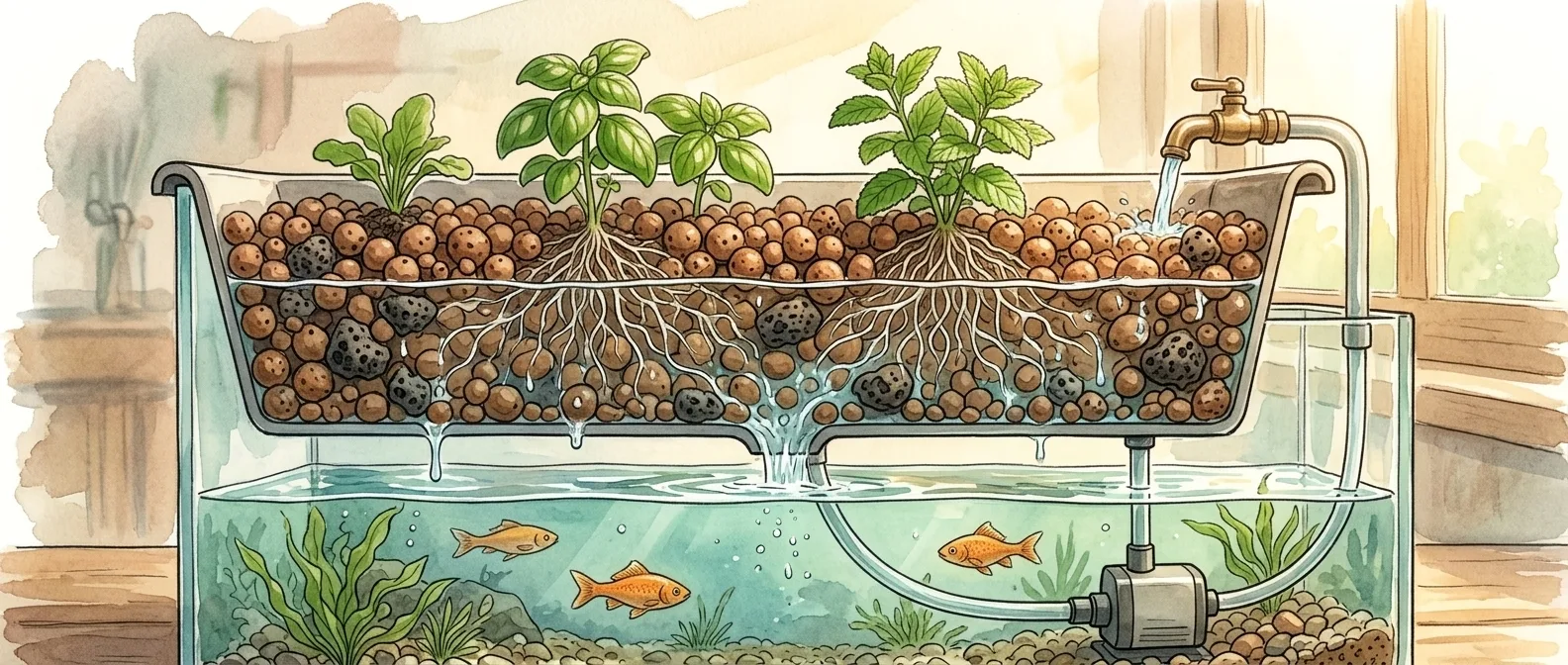
Filtration in an aquaponics system does two different jobs. Mechanical filtration catches solid waste, the fish droppings and bits of uneaten food you can see. Biological filtration converts dissolved ammonia, which you can't see, into nitrate through the bacteria described in our guide to the nitrogen cycle. Large commercial systems give each job its own tank. In a desktop or small system a single grow bed usually handles both, and it does that well as long as the media suits the job and the bed isn't asked to hold more waste than it can break down.
What mechanical filtration does
Solid waste keeps breaking down after it leaves the fish. Droppings and leftover food release ammonia as they decompose, and when they collect in corners with little flow they can rot without oxygen, producing hydrogen sulfide and the rotten-egg smell that signals trouble. Catching solids early keeps that load where you can deal with it.
In a small system the main mechanical filters are the grow bed itself, which traps particles as water passes through the media, and a sponge or foam pre-filter on the pump intake. The sponge earns its place twice. It stops fish, shrimp, and debris from being pulled into the pump, and it collects fine particles that would otherwise cloud the water. Squeeze it out in a bucket of tank water every couple of weeks, or whenever the flow drops.
Larger systems with heavy fish loads add a swirl filter or settling tank ahead of the grow beds, because a media bed fed too many solids will eventually clog. At desktop scale that's rarely needed if feeding stays modest.
What biological filtration needs
The bacteria need surface to grow on, oxygenated water moving across that surface, and enough open space between the pieces of media that water and roots can pass through without clogging. Porous media like expanded clay and lava rock offer far more surface than smooth stones of the same size, because bacteria colonize the pores and pits as well as the outside of each piece.
A media bed also handles mineralization. Other bacteria, along with any worms living in the bed, break trapped solids down into dissolved nutrients the plants can use. That's why many growers add red wigglers to larger media beds, and why a healthy bed rarely needs its solids cleaned out.
Choosing grow bed media
Expanded clay pebbles
Expanded clay, sold as LECA or under brand names like Hydroton, is the most common choice for small grow beds. It's light, close to pH-neutral once rinsed, easy to handle, and reusable for years. The FAO manual on small-scale aquaponics puts its surface area at about 250 to 300 square meters per cubic meter. New pebbles carry dust and sometimes an alkaline residue, so rinse them until the water runs clear and soak them before use. Some brands float at first and settle after a few days of wetting.
Lava rock
Lava rock, or volcanic gravel, costs less, is very porous, and is heavy enough to anchor plants well. The rough edges can scrape hands and roots, and it holds a lot of fine dust, so it needs a more thorough rinse. The FAO manual recommends pieces of about 8 to 20 mm. Finer grades pack down and restrict flow.
Gravel
River gravel works if it's the right kind. Limestone, marble, coral, and other carbonate rocks slowly dissolve and push pH up, which fights the slight acidity an aquaponics system needs. Test a handful by dropping it into vinegar. If it fizzes, it contains carbonate and doesn't belong in the grow bed. Inert gravel is heavy and has less surface area than porous media, but it costs little and lasts indefinitely.
Sponge and filter foam
Sponge filters and foam blocks hold a lot of bacteria for their size and double as mechanical filters. In systems without a media bed, such as a tank with plants rooted in floating baskets or a small raft, a sponge filter or a canister of bio-media carries the biological load a grow bed would otherwise handle. Plastic bio-balls and ceramic rings belong in that kind of filter too. They don't work as grow bed media because plant roots have nothing to grip.
Activated carbon removes dissolved organics and odors, but it does nothing for ammonia and has to be replaced once it's saturated. Most aquaponics systems leave it out.
Sizing the grow bed
For a small media-bed system, a grow bed holding roughly one-third to one-half of the tank's volume is a reasonable starting point, and our article on starting a desktop aquaponics system walks through the numbers for a 5-gallon tank. A deeper bed holds more bacteria and more trapped solids. The FAO manual recommends media beds about 30 cm deep for full-size systems, with the top 2 to 5 cm left dry to discourage algae and fungus, a root zone in the middle, and a zone at the bottom where solids collect and break down.
Desktop beds are far shallower than that, which is one reason they reward light stocking. If you want to keep more fish, add grow bed volume first, since it adds bacterial surface and plant uptake at the same time.
Keeping filtration working
Most filtration problems in small systems come down to flow. Check that water reaches the whole grow bed and, if you run flood-and-drain, that it drains fully, since dead spots don't support nitrifying bacteria and can turn anaerobic. Rinse the intake sponge in tank water when the flow slows. If you ever have to clean grow media, work in batches and use tank water, so most of the bacteria survive.
For the bigger picture of how the three filtration stages fit together, read how aquaponics filtration works. When something does go wrong, our troubleshooting guide lists the usual symptoms and what each one points to.