Fish guide
Choosing fish for a small or desktop aquaponics tank
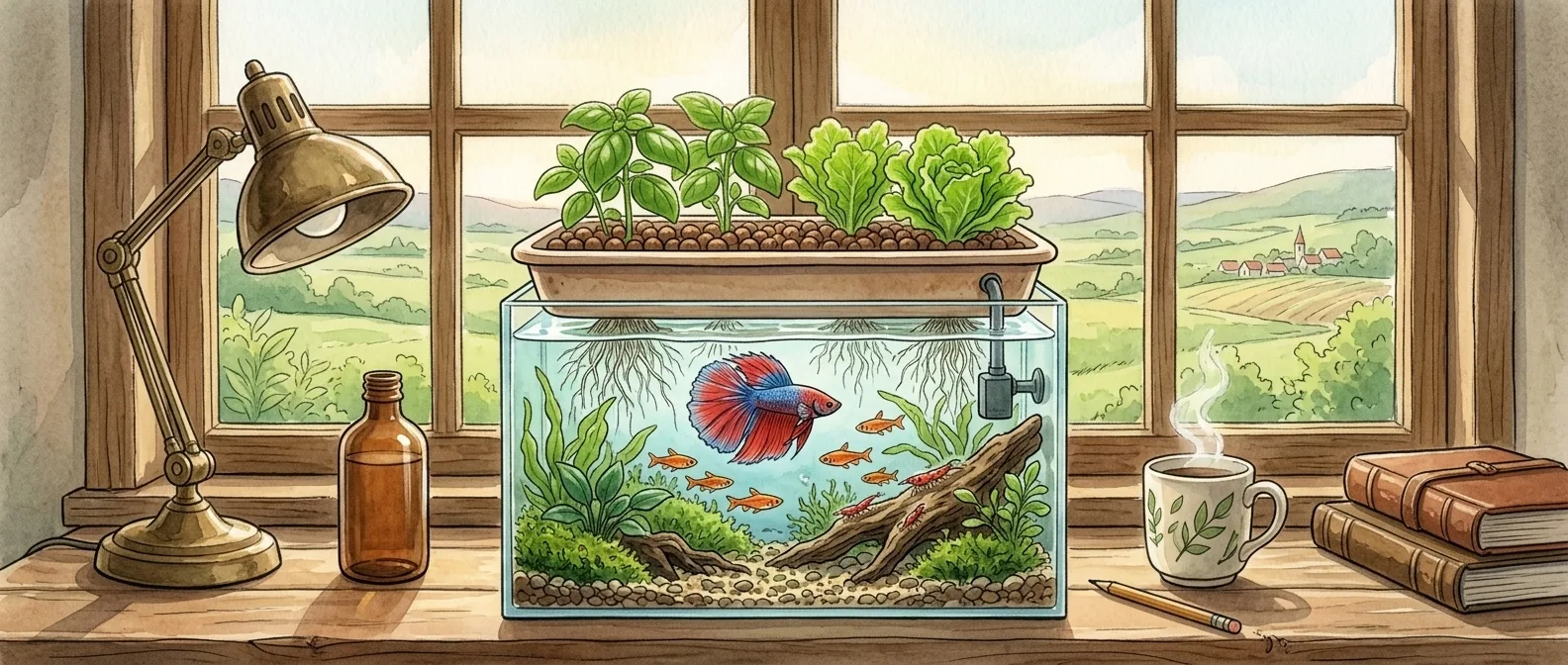
The fish set the pace of an aquaponics system. They produce the ammonia that feeds the bacteria and, through them, the plants, so their size, number, and appetite decide how much the grow bed has to handle. In a small system the right fish stays small, tolerates the near-neutral water that plants and bacteria share, and won't outgrow the tank within a year. Many of the fish recommended for aquaponics online are food fish that need hundreds of liters, so it pays to check adult size before anything else.
What makes a fish suit a small system
Start with adult size, since a juvenile that fits today can triple in length. Then match the fish to the temperature your room holds, or plan on a heater. Most tropical species want about 24 to 27°C (75 to 80°F), which in a typical home means a small adjustable heater, and in a few gallons it should be sized for the tank and checked with a separate thermometer.
Flow and temperament matter too. A pump that turns the tank over several times an hour suits active schooling fish but can push long-finned fish around, and territorial species need more room than a desktop tank offers. Our guide to water testing lists the ranges to keep in a system once it's stocked.
Good choices for 3 to 10 gallons
Betta
A single male betta is the classic desktop aquaponics fish. Bettas tolerate a wide range of water conditions, are content alone, and produce a light, steady waste load that a small grow bed can keep up with. Keep one per tank, give it 5 gallons where you can, and keep the water at about 25 to 28°C (77 to 82°F). Bettas come from still, shallow water, so baffle the return flow if the fish struggles against it. They breathe air at the surface as well as through their gills, so leave a gap between the water and the lid.
Small schooling fish
Chili rasboras and ember tetras grow to about 2 cm (under an inch) and do best in groups of six or more. Both prefer soft to moderately hard water that's neutral to slightly acidic, which suits aquaponics well. Their combined waste is small, so six to eight of them in a 5 to 10 gallon system is a gentle load for a desktop grow bed.
White cloud mountain minnows
White clouds are comfortable in cooler water than most aquarium fish, roughly 18 to 22°C (64 to 72°F), so many homes can keep them without a heater. They're active swimmers that like groups of six or more. They can live in a 5-gallon system, although a 10-gallon tank gives a group more room to school.
Guppies and endlers
Livebearers like guppies and endlers are hardy, colorful, and forgiving of beginner mistakes. Their drawback is breeding. A mixed group multiplies quickly, and a desktop system can be overstocked within a few months, so keep males only unless you have homes lined up for the fry.
Shrimp and snails
Cherry shrimp (Neocaridina) add very little waste and clean up leftover food and algae, which makes them a good fit for the smallest systems, either on their own or with small peaceful fish. Bettas sometimes hunt them, so give shrimp plenty of plants to hide in if you combine the two. Shrimp are sensitive to copper and to ammonia or nitrite spikes, so add them only to a fully cycled system and check that any plant supplement is safe for invertebrates, as our guide to plant nutrient deficiencies explains. Nerite snails graze algae from glass and media and don't breed in fresh water.
Fish to leave out of a small system
Goldfish are the usual mistake. They're sold small and cheap, but common and comet goldfish can grow to a foot long and belong in ponds, and even fancy goldfish reach 15 to 20 cm (6 to 8 inches) and produce a heavy waste load. Keep them out of systems under about 20 gallons, and plan on more than that for a group.
Tilapia, catfish, trout, and other food fish are the standard choice for backyard aquaponics, but they grow too large and too fast for anything that fits on a desk. Tilapia also face restrictions in some US states, so check local rules before buying them for a larger build. Common plecos, often sold as algae eaters, can grow past 30 cm (a foot) and produce a lot of waste. Snails and shrimp handle algae in a small tank with far less load.
How many fish
Rules of thumb like an inch of fish per gallon are crude, because one 4-inch fish produces far more waste than four 1-inch fish. In aquaponics the better guide is the system's own test results. The target is a system that keeps ammonia and nitrite at zero and nitrate steady, and you reach it by adding fish slowly and testing as you go.
For a 5-gallon desktop system, one betta or a group of six to eight nano fish is a sensible ceiling, which matches the stocking in our article on starting a desktop aquaponics system. Our guide to feeding and stocking explains how to add fish in stages and how to tell when a system has reached its limit.
Before you bring fish home
Add fish only to a cycled system, which our guide to cycling a new system shows how to confirm. Bring the tank to the right temperature a day before the fish arrive. Float the sealed bag for 15 to 20 minutes so the temperatures match, add a little tank water to the bag a few times over the next 20 minutes, and then net the fish into the tank so the store water stays out of your system.